What is 'Agentic AI' and Why Does Your Business Need a Dashboard for It?
The "Cockpit" Paradox: Power vs. Control
In the 2026 enterprise landscape, the fundamental challenge of Artificial Intelligence has shifted. Most organisations have successfully acquired a high-performance "jet engine" in the form of Generative AI, providing incredible "thrust," the capacity to process information at unprecedented speeds. However, the majority of these businesses are currently flying blind. They possess raw power but lack the instrumentation to steer it toward high-stakes business outcomes.
We have officially exited the 2022 "Chatbot" era of reactive systems. We are now firmly in the Agentic Era. This marks the transition of AI from a tool you "query" to a workforce you "manage." In a world where open-source models like DeepSeek have democratised reasoning, the competitive advantage lies with those who possess the superior "cockpit" to coordinate them.
Defining the 2026 Landscape: Beyond the Chatbox
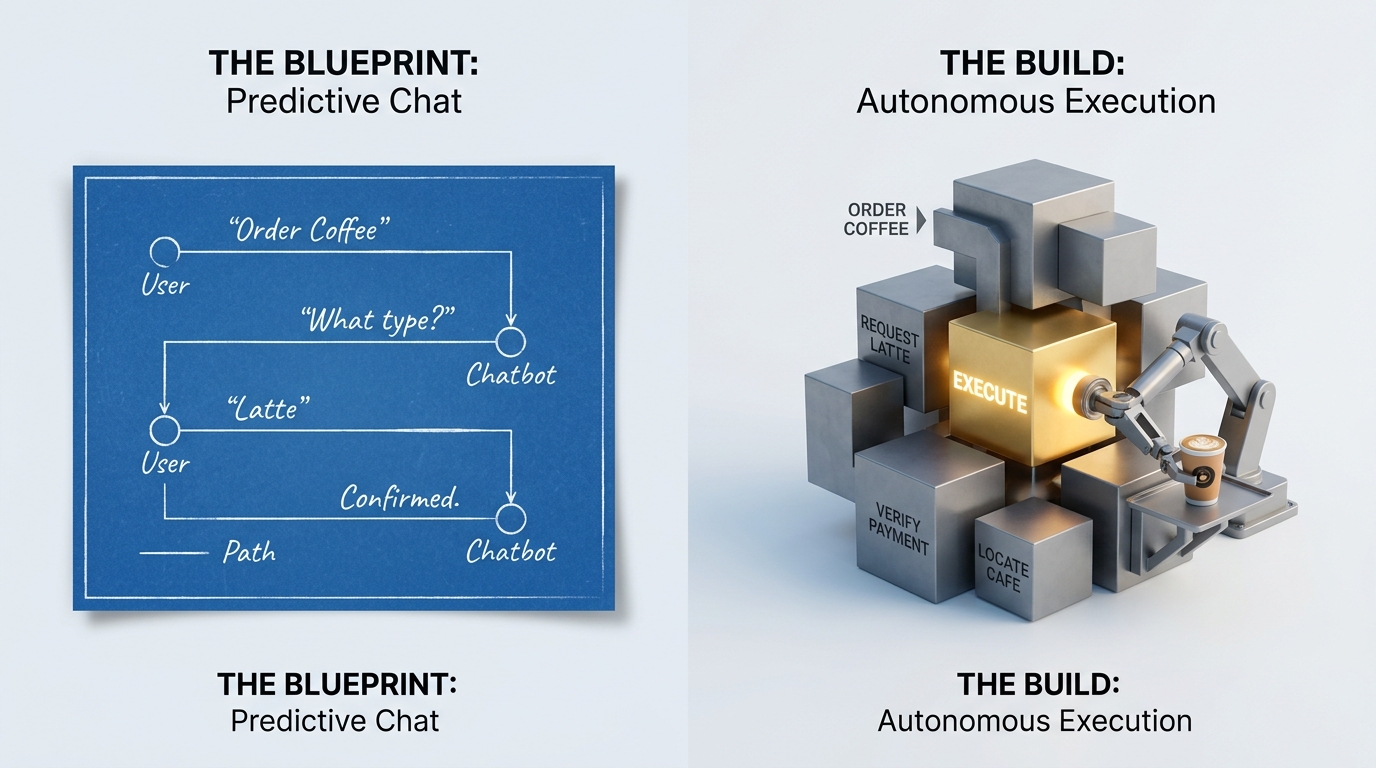
The modern AI workforce is composed of autonomous agents that function as digital "workers" and "consultants," operating on three core pillars: Plan, Verify, and Execute.
- Plan: Agents take a high-level strategic goal, such as "Increase Q3 Sales," and autonomously decompose it into executable sub-tasks, including lead scoring, personalised outreach, and CRM synchronisation.
- Verify (The Reasoning Revolution): 2025 marked the rise of "reasoning models" like OpenAI's o3 and DeepSeek R1. These systems utilise "test-time compute scaling," meaning they spend extra time "thinking" and self-correcting. A dashboard is now required to manage the time an agent spends thinking, not just the final output.
- Execute: Agents have moved beyond the chat interface to interact directly with APIs, databases, and enterprise software. They autonomously update records and handle workflows that previously required human intervention.
| Feature | Traditional Chatbots (2022) | Autonomous Agents (2026) |
|---|---|---|
| Interaction Style | Reactive; waits for prompts | Proactive; pursues goals |
| Goal Handling | Single-turn responses | Multi-step autonomous plans |
| Reasoning | Immediate token generation | Test-time search and reflection |
| Tool Use | Limited to chat window | Full API and CRM integration |
The Technical Engine: RAG and SLMs
The shift to "right-sized" architectures is now a fiscal imperative. To build a reliable agentic workforce, enterprises are moving toward specialised stacks:
- Retrieval-Augmented Generation (RAG): Providing agents with real-time access to proprietary data cuts hallucination rates by up to 30%, moving models closer to the precision required for enterprise workflows.
- Small Language Models (SLMs): Organisations are increasingly deploying "master of one" models like NVIDIA Nemotron Nano 2 (9B parameters). These are more cost-effective and can consume up to 80% less power than their full-scale counterparts.
The $156,000 Saving: Transitioning from public APIs to self-hosting models via vLLM on a Reserved Instance (like AWS g5.xlarge) can save a high-volume organisation approximately $156,276 per year.
Why Your Business Needs a Command Centre (The Dashboard)

Managing an autonomous workforce through a simple text box is an operational liability. A sophisticated Agentic Dashboard provides four critical functions:
- Visibility: It tracks the reasoning chains. Managers must be able to audit the intermediate steps an agent takes during "test-time" before it reaches a conclusion.
- Deliberative Alignment: Modern Dashboards ensure agents follow safety protocols, where the model is trained to internally reference company-specific policies during its reasoning process.
- Cost Management: Provides a "single pane of glass" to monitor token usage and infrastructure efficiency.
- Human-in-the-Loop: For high-stakes decisions, the Dashboard provides a manual override, ensuring human accountability remains the final arbiter.
The MyBizz Promise: Managing the Workforce
While many vendors are selling the "Engine," MyBizz provides the "Cockpit." We recognise that in 2026, the value is not in the model itself, but in the orchestration of the outcomes it produces.
The MyBizz Dashboard is the only platform that integrates Deliberative Alignment and token-level cost management into a single, authoritative interface. Stop "querying" and start "commanding."
How this applies in practice
Most businesses already use multiple tools to run their operations , CRM, accounting, project management, communications. The challenge is that none of these tools talk to each other cleanly. A business dashboard built on top of proper data integration gives leadership a single view of what is actually happening across the organisation, without relying on manual reports or status meetings. This is where workflow automation becomes practical: connecting inputs, routing decisions, surfacing exceptions, and tracking outcomes in one place. Whether the focus is finance, operations, or client delivery, the principle is the same , reduce manual workflows and improve visibility. See how spreadsheet-driven businesses are making this shift in our article on replacing legacy spreadsheets, or get in touch to discuss your needs.
Want to learn more about how we can help your business? Explore our automation systems, read about our AI consulting approach, or get in touch.